

The 22nd International Conference on Strangeness in Quark Matter:
SQM 2026: 22-27 March 2026
ALICE presentations in SQM 2026 are listed HERE.
ALICE highlights:
-
Chiara Pinto (Munich)
-
Fabio Catalano (Houston)
ALICE best poster awards (flash talks): Congratulations!!
JSPC Journal Award for Early Career Research:
-
Vojtec Machacek (Copenhagen)
The ALICE Collaboration presents a wide range of new physics results at the International Conference on Strangeness in Quark Matter (SQM2026), taking place this week (22-27 March 2026) in Los Angeles. The SQM conference series focuses on strange and heavy quark probes as tools to investigate the properties of quark-gluon plasma (QGP) and to provide key input for related fields such as nuclear astrophysics, including the study of compact stars and cosmic rays. The 2026 edition of SQM brings recent experimental and theoretical advances on a broad range of topics in quantum chromodynamics (QCD) at high temperature, high energy, and finite baryon density. The ALICE Collaboration is represented at SQM2026 with 2 plenary and 25 parallel talks as well as 13 poster presentations. These will bring a wealth of results based on data from the LHC Run 3, ranging from lead-lead (Pb-Pb) to proton-proton (pp) and light-ion collisions.
A selection of these results is summarised below, illustrating the unique insights provided by ALICE across different stages of the collision evolution: from collective phenomena associated with the possible formation of the QGP to the mechanisms governing the hadronisation of light and heavy-flavour hadrons, and finally to the study of the strong interaction among the produced hadrons in the hadronic phase.
First measurement ot the charm baryon Λc+ elliptic flow (arXiv:2603.18966)
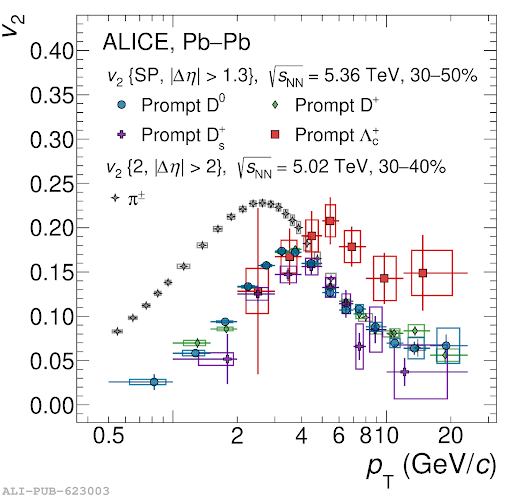
Thanks to the large Pb-Pb data sample and to the enhanced spatial resolution of the upgraded ALICE Inner Tracking system, the first-ever measurement of the prompt Λc+ baryon elliptic flow v2 was obtained at a center-of-mass energy per nucleon pair of √sNN = 5.36 TeV. The results appeared recently on arXiv (arXiv:2603.18966). A characteristic baryon-meson splitting of v2 at intermediate transverse momentum, commonly interpreted as a consequence of quark recombination of partons propagating in a common velocity field and already observed for light-flavour hadrons, is now also experimentally observed in the charm sector.
Also, light hypernuclei are flowing! (arXiv:2603.19398)
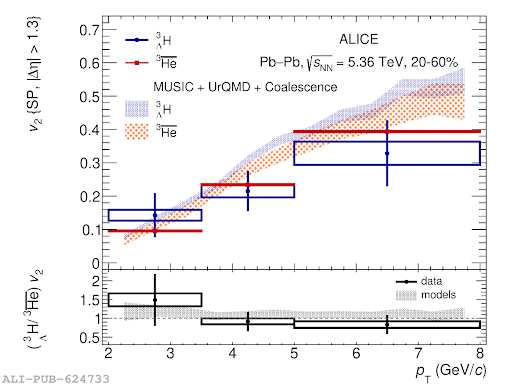
The elliptic flow of light (hyper)nuclei provides important insight into the production mechanism of loosely bound states in heavy-ion collisions. ALICE has now published the first measurement of v2 of the hypertriton Λ3H in Pb-Pb collisions at √sNN = 5.36 TeV using the scalar-product method (arXiv:2603.19398). The measured v2 of the hypertriton is found to be compatible, within uncertainties, with that of 3He, despite the hypertriton having a much larger spatial size due to its extremely weak binding energy. This observation indicates that the elliptic flow is largely determined at the level of the constituent nucleons and is insensitive to the final size of the composite object. Furthermore, the observation of a large elliptic flow coefficient for 3He - exceeding a value of 0.5 - is a key signature of formation via coalescence, a scenario in which nuclei would exhibit stronger azimuthal modulation than the particles that coalesce into them.
Are particles also flowing in light-ion collisions?
The LHC Run 3 data-taking period was able not only to provide a significant increase in the collected statistics for Pb-Pb collisions but also to deliver the first light-ion collisions (OO, Ne-Ne) at LHC.
ALICE presents new preliminary measurements of identified-particle elliptic flow v2 in OO collisions at √sNN = 5.36 TeV, adding particle identification to the flow studies of light-ion collision systems. The results show a clear mass ordering of v2 at low transverse momentum, consistent with the collective expansion of the medium. Furthermore, a baryon-meson splitting is observed at intermediate transverse momenta. In particular, after a pT of approximately 2 GeV/c, the Φ meson follows the behaviour of other mesons, despite its mass being comparable to that of baryons such as the proton and the Λ.
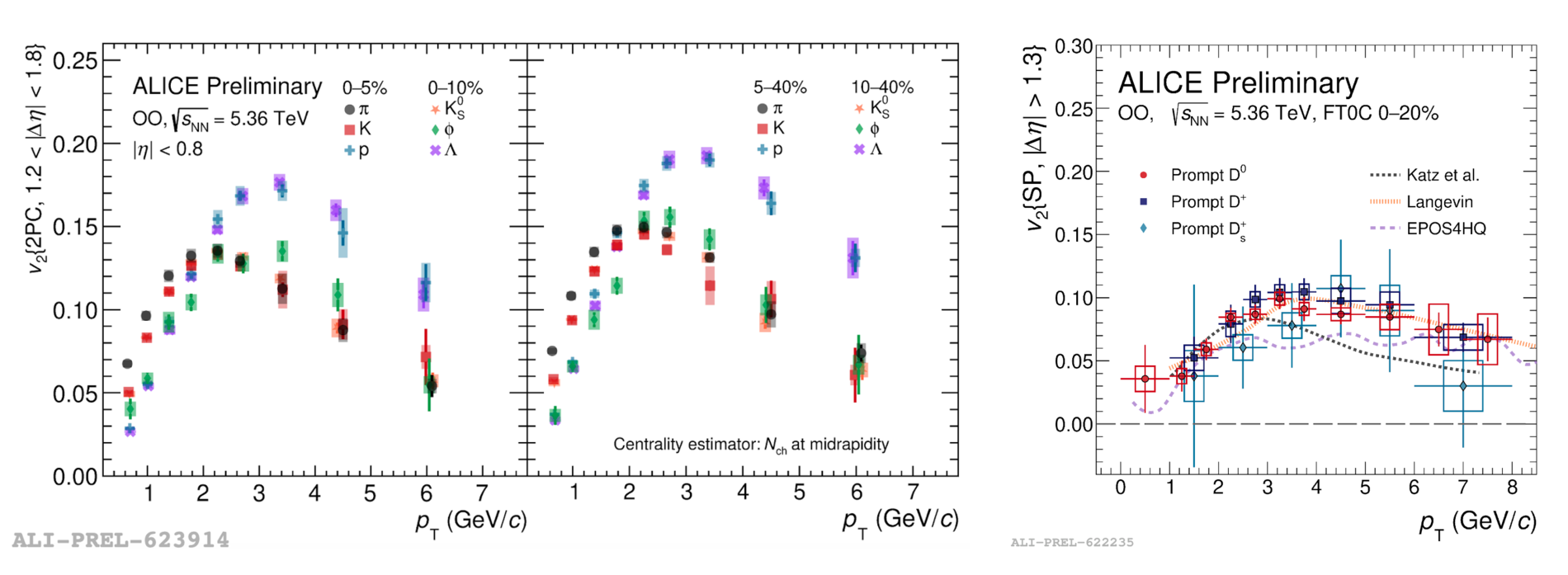
This observation highlights that the splitting is driven by the number of constituent quarks rather than by the particle mass. The measurement therefore provides further support for the presence of partonic collectivity and for a recombination-driven hadronisation mechanism also in OO collisions, as reported in Pb-Pb and in high-multiplicity pp and p-Pb collisions.
Further systematic measurements of the elliptic flow for different identified particles are being carried out to characterise the conditions required for the appearance of collectivity and medium effects. To that end, the v2 of charm D mesons has been measured to be significant in OO collisions, despite the significantly smaller system size. The results on the elliptic flow v2 of prompt D0, D+, and Ds+ are shown in the right figure as a function of the transverse momentum for OO collisions at √sNN = 5.36 TeV. The measured v2 is qualitatively described by transport models that include the presence of a QGP phase.
Probing the onset of medium effects with quarkonium in OO collisions
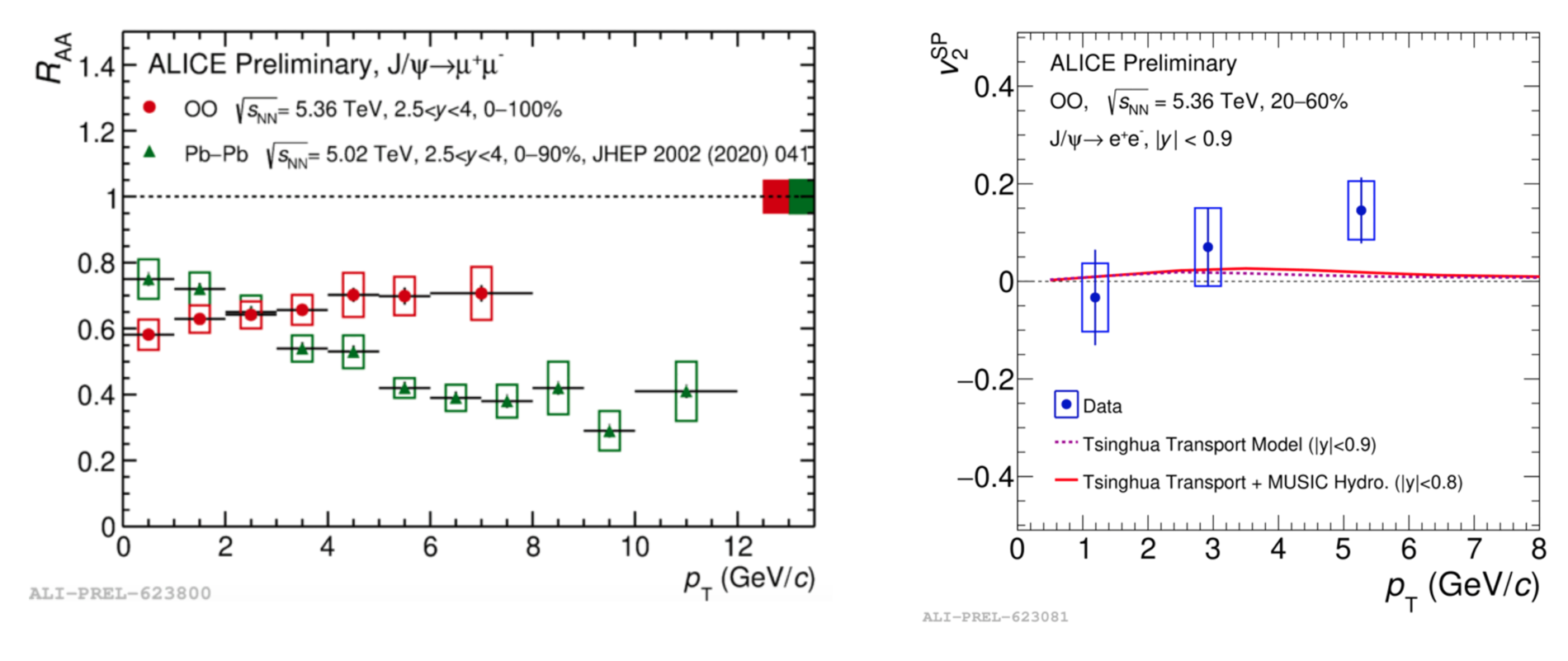
Preliminary measurements of the J/ψ nuclear modification factor ROO collisions at √sNN = 5.36 TeV reveal a remarkably different trend vs pT with respect to Pb-Pb collisions. At low pT, the nuclear modification factor is stronger in OO than in Pb-Pb, indicating that a larger regeneration could be at play in Pb-Pb with respect to OO collisions. A clear difference is observed also at intermediate and high pT, where the suppression is smaller for OO collisions. This suggests a different interplay between suppression and regeneration contributions. The first measurement of the J/ψ v2 has also been reported and points to an elliptic flow consistent with zero within uncertainties, a result that is consistent with transport models that include an expanding medium and which predict a very small J/ψ v2.
Resonances surviving the hadronic phase in OO collisions
Strangeness production has long been considered a key probe of the hot and dense QCD medium created in heavy-ion collisions, with an enhanced production of strange hadrons historically proposed as a signature of quark–gluon plasma formation. Measurements across collision systems have shown that strange-hadron production scales primarily with the final-state multiplicity rather than with the system geometry or beam energy, making OO collisions an ideal system to bridge small and large collision systems and to test the origin of this scaling behaviour.
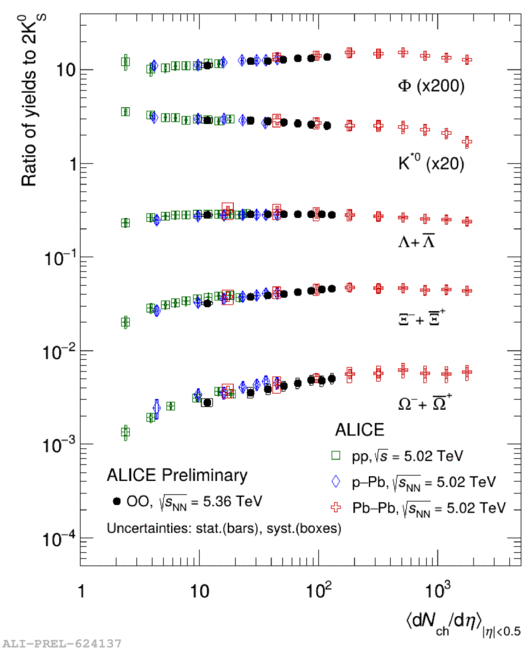 ALICE presents the first measurement of strange hadron and resonance production in OO collisions at 5.36 TeV. The ratio of K* to Ks0 shows a decreasing trend with increasing multiplicity, consistent with the suppression of short-lived resonances due to rescattering in the hadronic phase. On the contrary, the Φ/K0s ratio stays approximately constant, reflecting the much longer lifetime of the Φ meson, which makes it largely insensitive to hadronic phase effects. The yields of strange and multi-strange hadrons (Λ, K0s, Ξ, and Ω) exhibit the familiar increase with event multiplicity already observed in other collision systems. When compared across systems, the OO results follow the same smooth strangeness-content-dependent scaling from pp to Pb–Pb collisions. The enhancement becomes stronger for particles carrying higher strangeness content, supporting the picture of a universal strangeness production mechanism driven by the final-state multiplicity.
New insights into hadronisation of strange-charm hadrons with multiplicity studies of Ds/D
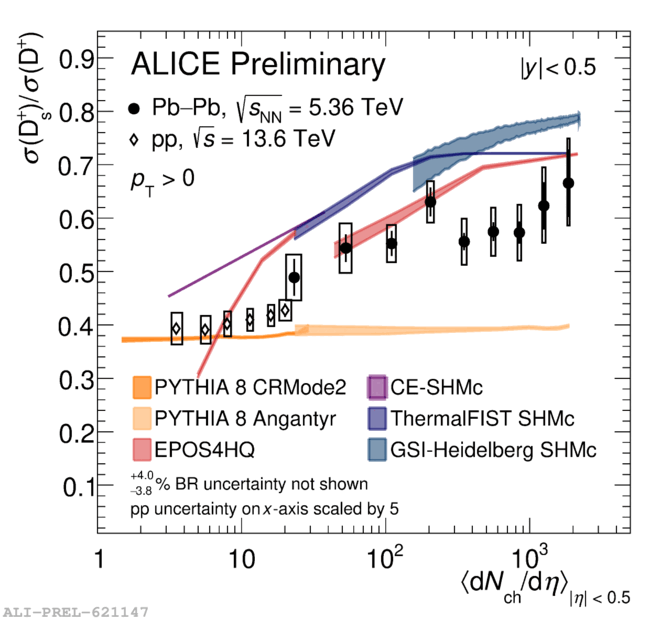 ALICE released new, unprecedentedly precise measurements of the strange-to-non-strange meson ratio Ds+/D0 in fine centrality intervals, aiming at constraining hadronization across different collision systems. In pp collisions, from very low to high multiplicity, the Ds+/D0 yield ratio shows no significant dependence on multiplicity and pT, as expected by models that assume independent fragmentation. In contrast, significantly larger yield ratios are observed in Pb–Pb collisions, increasing towards more central collisions. Describing this observation presents a challenge to models incorporating different hadronization mechanisms, which currently fail to simultaneously reproduce the data across the full multiplicity range and across different collision systems.
Accessing the final state interaction with charm and strange hadrons
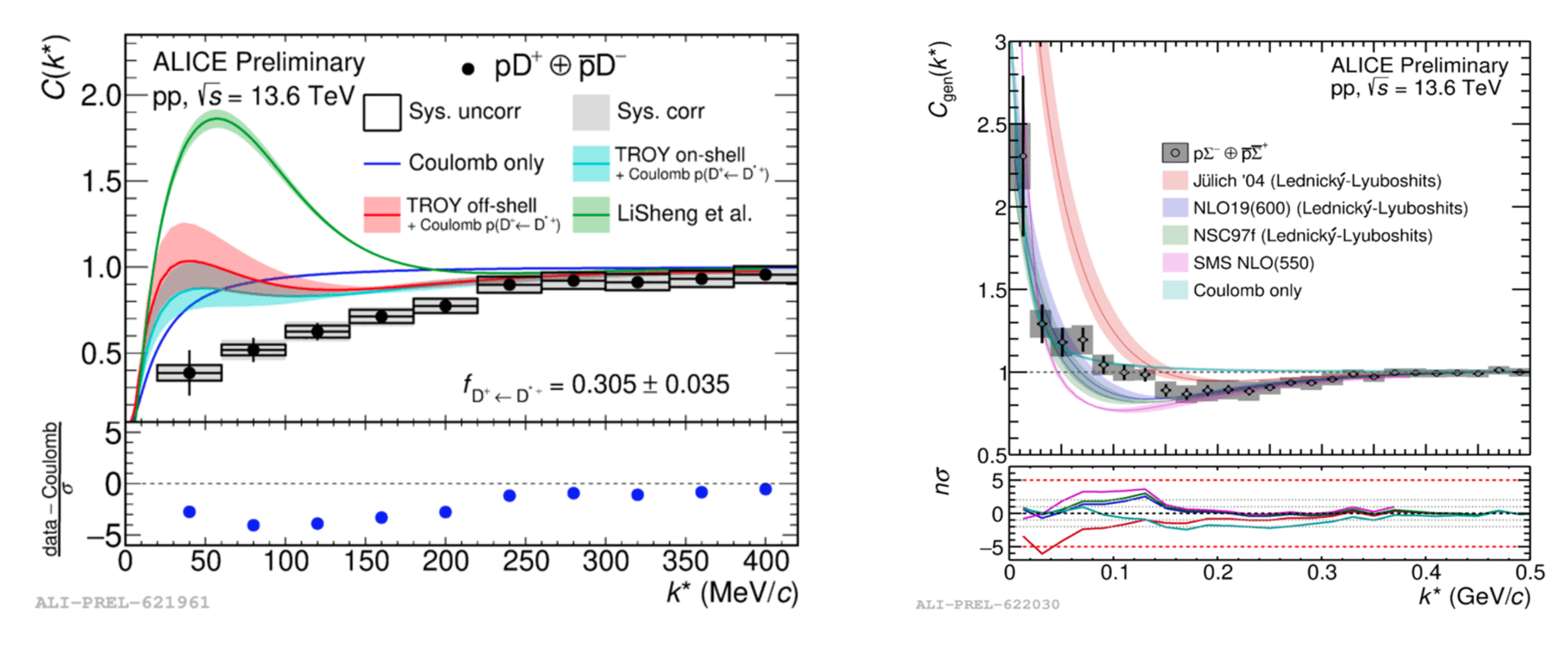
Accessing the residual strong force between hadrons with charm and strange content is extremely challenging due to their very short lifetimes, which makes it practically unfeasible to have stable beams and targets. With the data sample collected during Run 2, ALICE has been delivering high-precision data on many interactions involving strange and charm particles thanks to the femtoscopy technique. The basics of this approach rely on the measurements of two-particle correlation functions in the relative momentum space of the pair of interest.
With the enhanced Run 3 statistics in pp collisions at 13.6 TeV and thanks to the development of dedicated offline triggers, the first measurement of a proton interacting with a D+ meson was performed, providing the first evidence of residual strong interaction in the
charm sector (left figure).
In addition, the upgrade of the ITS, with the inclusion of an additional layer, allowed for the possibility of reconstructing Σ- baryons via their hadronic decay into neutrons and pions. ALICE reports the first measurement of the pΣ- correlation function, delivering important input for understanding the behaviour of strange baryons in dense nuclear matter. The measured correlation indicates a slightly repulsive NΣ interaction, which is in tension with available models.
In addition, the femtoscopy technique has also been extended to the triplet case, providing unique access to three-body dynamics and allowing ALICE to present the first femtoscopic measurement of a three-baryon system in the strangeness sector, studying the ppΞ correlation. The data show evidence of a final-state interaction, with a significant deviation from the Coulomb-only scenario at low Q3.
First measurement of fully reconstructed B0 meson at very low pT at midrapidity (arXiv:2603.18904)
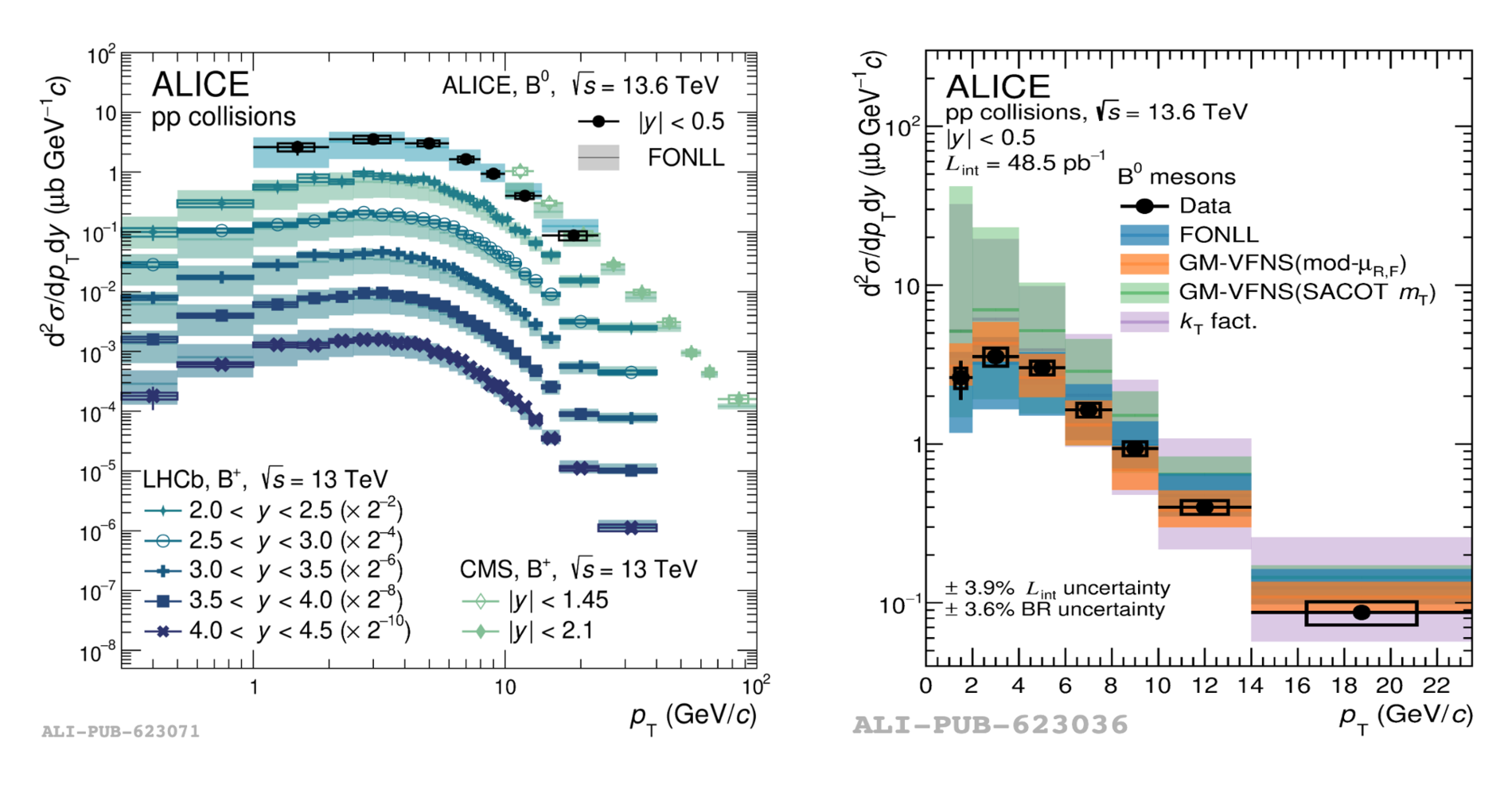
Another important result enabled by the large sample of pp collisions collected in 2023 and 2024 (Lint ≃ 50 pb-1) and exploiting offline triggers for rare-channels is the measurement of the B0 production cross section via full hadronic reconstruction performed for the first time at midrapidity (|y| < 0.5) down to pT = 1 GeV/c, at √s = 13.6 TeV (arXiv:2603.18904). The measurement significantly extends the kinematic region of previous results of beauty hadrons performed by the CMS and the LHCb Collaborations. Further, a preliminary measurement of the B+ meson cross section is also being made available at SQM2026 and complements the existing publication. These precise measurements provide constraints to pQCD calculations and serve as a crucial reference for future measurements in heavy-ion collisions, where the production of beauty hadrons is expected to be modified at low pT due to the interaction of beauty quarks in the colour-deconfined medium.