

CERN News: ALICE solves mystery of light-nuclei survival
Nature Article: Observation of deuteron and antideuteron formation from resonance-decay nucleons
Nature volume 648, pages306–311 (2025)
Link to the publication in ALICE website
Particle collisions at the Large Hadron Collider (LHC) can reach temperatures over one hundred thousand times hotter than at the centre of the Sun. Yet, somehow, light atomic nuclei and their antimatter counterparts emerge from this scorching environment unscathed, even though the bonds holding the nuclei together would normally be expected to break at a much lower temperature. Physicists have puzzled for decades over how this is possible, but now the ALICE collaboration has provided experimental evidence of how it happens, with its results published in Nature.
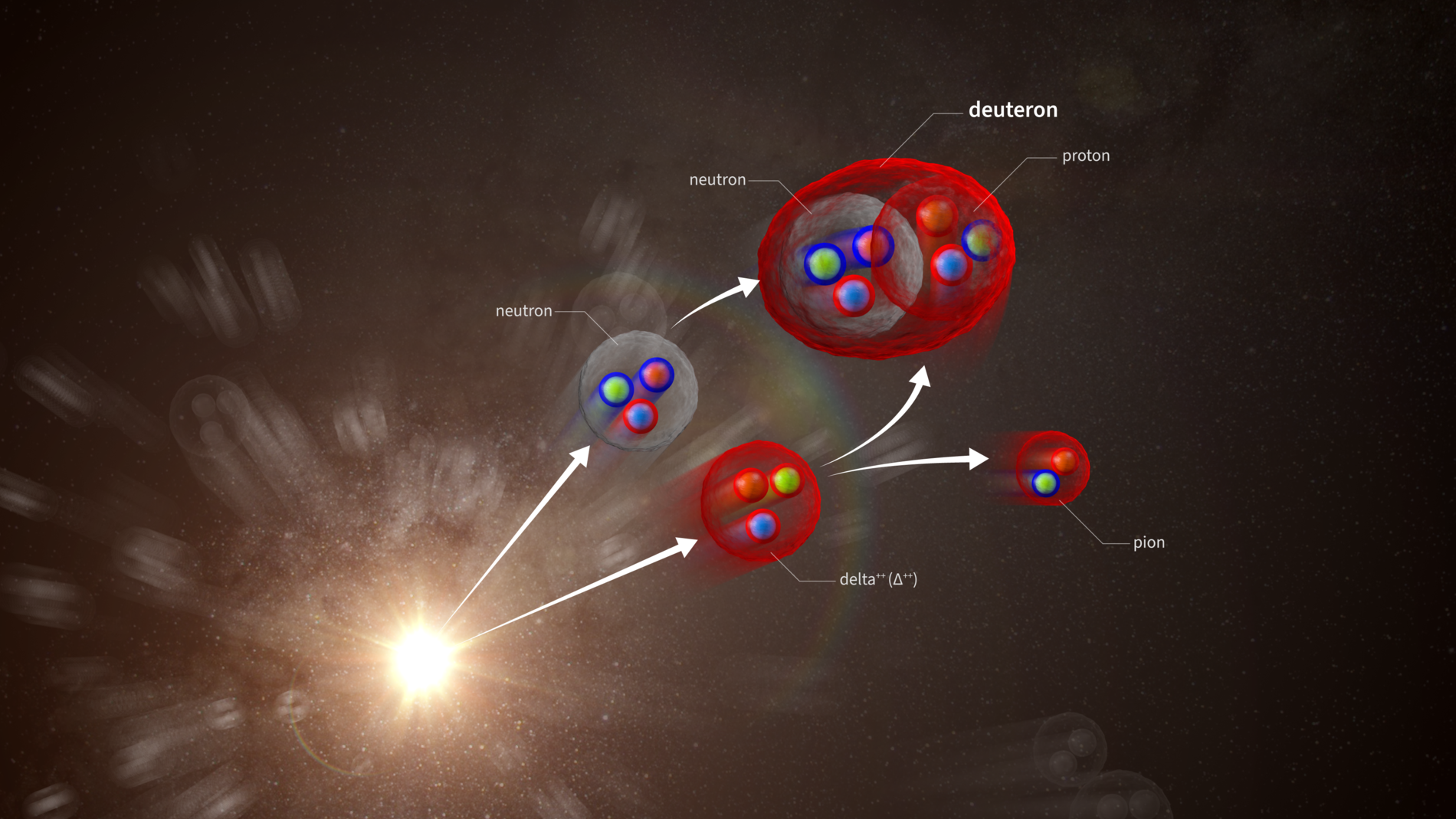
Illustration of how deuterons can be produced from a high-energy collision at the LHC. A delta particle emerging from the collision decays into a proton and a pion. The proton undergoes nuclear fusion with a neutron to form deuteron (Image: CERN)
(Photo Credit: Marcel Lesch)