

ALICE explores possible QGP-like effects in oxygen-oxygen collisions by studying how energetic particles lose energy as they move through the system.
Nicolas Strangmann presented these results at the CERN-LHC Seminar on 21 July.
ALICE Collab 2026: arXiv:2606.19967
When heavy atomic nuclei collide at nearly the speed of light inside CERN’s Large Hadron Collider (LHC), they produce an extreme state of matter known as the quark-gluon plasma (QGP). At temperatures of over one hundred thousand times hotter than the center of the Sun, quarks and gluons - the fundamental building blocks of protons and neutrons - are briefly freed from their usual confinement, recreating conditions that existed just microseconds after the Big Bang.
For many years, physicists have studied the quark-gluon plasma using collisions of heavy nuclei, such as lead or gold, which contain about 200 protons and neutrons. One year ago today, the LHC collided oxygen nuclei for the first time, containing only 16 protons and neutrons. Since then, all LHC experiments have observed particle-flow patterns reminiscent of those seen in much larger heavy-ion collisions, and originally seen as one of the signatures of the QGP. These findings raise an important question: how small can a collision system be and still produce a quark-gluon plasma?
While signs of QGP formation continue to appear in proton-proton and proton-lead collisions, a new result from the ALICE experiment brings us one step closer to a definitive answer.
The collaboration has found evidence for parton energy loss – one of the clearest signatures of quark–gluon plasma formation – in collisions of oxygen nuclei. This phenomenon occurs when high-energy quarks and gluons (partons) produced in a collision pass through the hot medium and lose energy, resulting in fewer high-energy particles than expected. While this suppression is well established in collisions of heavy nuclei such as lead or gold, it has remained elusive in smaller systems. Recent measurements by the CMS experiment have already observed such a suppression in oxygen–oxygen collisions, hinting at parton energy loss in this system.
Establishing the origin of this suppression, however, is far from straightforward. Similar effects can arise from conventional nuclear phenomena unrelated to the formation of quark-gluon plasma. To disentangle these contributions, ALICE exploited both oxygen–oxygen and proton–oxygen collisions provided by the LHC in 2025. While proton–oxygen collisions are expected to exhibit many of the same nuclear effects as oxygen–oxygen collisions, they are not expected to produce a medium large enough to cause substantial parton energy loss.
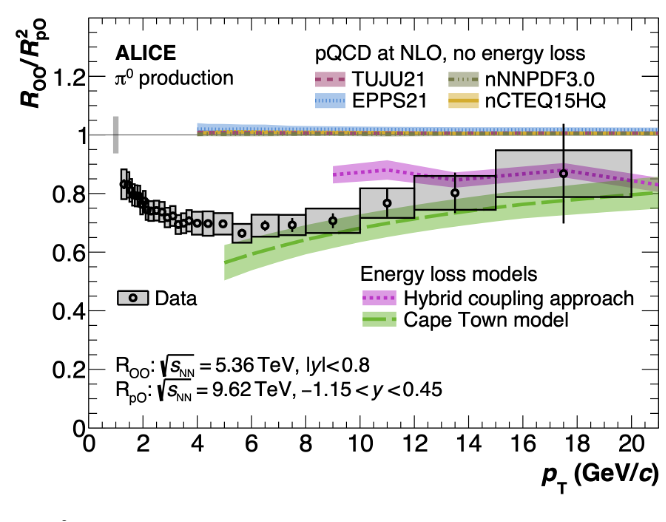
As shown in the figure above, ALICE carried out this comparison using neutral pions (π⁰), reconstructed from their decay into two photons detected by the Electromagnetic Calorimeter (EMCal). Differences between pion production in the two collision systems can be used to isolate signatures of parton energy loss from conventional nuclear effects. The remaining pion suppression measured provides unambiguous evidence that high-energy partons lose energy in oxygen–oxygen collisions, extending this hallmark signature of quark–gluon plasma formation to the smallest nuclear collision system explored so far.
ALICE Physics Coordinator David Chinellato remarks: “The evidence of parton energy loss we have established in oxygen collisions is 4.9σ away from the null hypothesis, meaning a 1 in 2 million chance of being an accident.” Together with other measurements from across the LHC, this result marks an important milestone in the effort to understand the smallest systems capable of exhibiting quark-gluon plasma behavior.
“The 2025 oxygen run is far from finished in terms of physics output,” says ALICE Spokesperson Kai Schweda. “With many measurements still emerging, the results promise an unprecedented view of how strongly interacting matter evolves under extreme conditions from the smallest to the largest systems we can create in the laboratory.”
These results were presented by Nicolas Strangmann at a CERN-LHC Seminar on 21 July 2026.
Further reading:
ALICE Collab 2026: arXiv:2606.19967